



Nothing to break
No streaks, no longest run, no completion percentage and nothing that turns red. Food targets are off unless you ask for them. A hard day is entered as a day, and every day in front of it stays in the record.
Kintsugi is a wellbeing and productivity app for the unglamorous work of putting things back together — focus, movement, stillness, staying off it, and the ordinary skills nobody taught you.
Built in Belfast. No adverts, no tracking, and nothing that resets to zero when you have a bad day.
Kintsugi is the Japanese craft of repairing broken pottery with lacquer and powdered gold. The join is not hidden or sanded flush. It is drawn in a bright line straight through the middle of the piece, and the repaired bowl is worth more than the unbroken one was.
That is the entire argument of this app. Not that the break did not matter — it did, and it probably cost you something. But the mending is real work, it leaves a mark, and the mark is not a defect in the object. It is the most interesting thing about it.
What the app actually does is much more ordinary than that sounds. It helps you pick one thing to do today instead of twenty. It gives you a bodyweight workout you can do on a floor. It holds a written practice for the ten minutes before bed. It counts the days since you stopped, and it does not reset that count to zero when you have a bad one. Small tools, used on the days you can use them.
Recovery, ADHD, mood, grief, learning, community and local life — instead of five separate apps that do not know each other, so the craving tool and the running club are part of the same story.
Capture anything in one field, pick the one thing that would make today count, and work in honest, pausable time. It is very good at this — good enough that plenty of people come for the planner and stay for the rest.
Transactional Analysis and the drama triangle for spotting your own patterns, Jungian shadow work, and ADHD read strengths-first. Kitchen-table language, not clinical jargon.
Where the money actually goes, kinder systems for an income that is not the same every month, and the unopened-post problem taken seriously. Manual only — it never asks for your bank login.
Prompts when you cannot start a sentence, a blank page when you can. Mood and tags quietly build a picture over months without you doing anything clever with it.
Bodyweight sessions from first-week beginner to one-arm work, every movement with an easier version. No gym, no kit, no scoring — start where you actually are.
Log what you ate and drank, with the numbers off unless you want them. Turn on calories, protein or water individually, or keep it a plain record — your choice, changeable any time.
Help winding down first, gentle logging second. No sleep score to fail, because a number telling you that you slept badly is how an ordinary bad night becomes a worry.
Short Stoic, mindfulness and breathwork practices, each honest about what it is for and how long it takes. Two minutes counts. None of them needs a mat or a quiet hour.
People working on the same things, rooms worth being in, and clubs built around what fills a life — a running group, a chess club, a reading circle. Moderated, with age checks where they matter.
Time counted the way you choose and never reset to nothing, alongside real tools for the hard hour — urge surfing, grounding, HALT, playing the tape forward.
A break-up, a divorce, a bereavement, or a stretch that simply will not lift. Something steady to hold the ordinary scaffolding while the rest of it settles.
Always on screen, signed in or not — Samaritans, Lifeline and Shout, straight through. There if you ever need it, and quietly out of the way if you do not.
Everything you think of goes in the inbox so you are not carrying it. Then one task is nominated as the one that would make today count, and a timer counts honest, pausable time — four minutes is recorded as four minutes. Nothing is ever marked late.
Recovery, insights, sleep, routines, courses, community and chat, a practitioner directory and a way to find real help — in one place, so the craving tool and the running club are part of the same story rather than living in apps that do not know each other.
Prompts drawn from depth psychology, or a blank page when you would rather. Mood and tags build a picture over months without you having to do anything clever with it, and no insight ever becomes a streak to protect.
Time free counted the way you choose, and a number that only grows. Milestones are earned for good — a lapse never takes one back, and nothing resets to zero. There is a plain day counter too, if that suits you better.
Food logging ships with calorie and protein targets switched off entirely. Turn on what helps and leave the rest — and where a figure does appear, it is a reference rather than a ceiling. Nothing counts down and nothing turns red.
Transactional Analysis and the drama triangle for spotting your own patterns, Jungian shadow work, ADHD read strengths-first, and honest companions for grief, break-ups, anxiety and money. Kitchen-table language, never clinical jargon.
Real screens from the app, not renders of a version that does not exist.

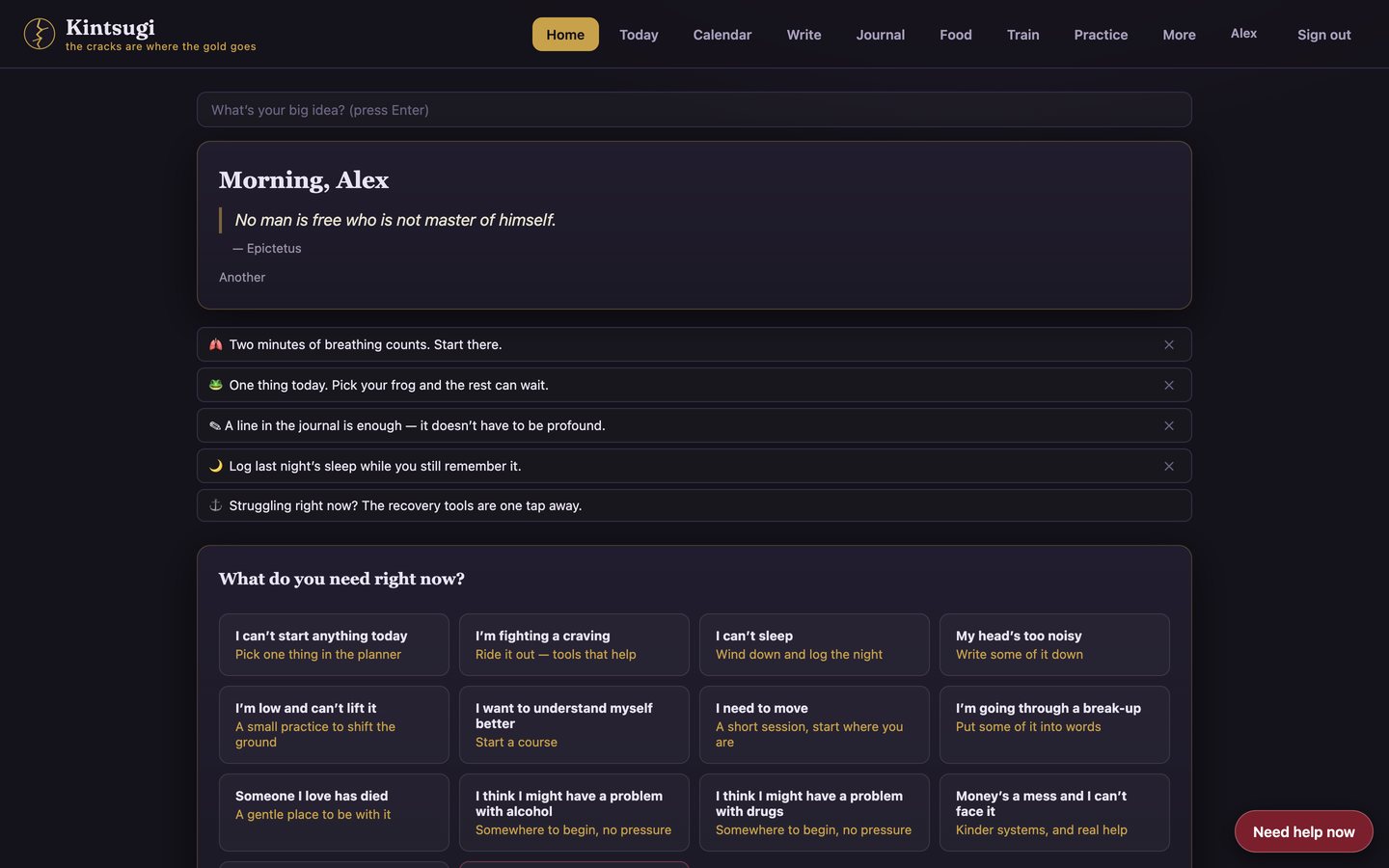
The Kintsugi home screen, asking what you need right now, with routes for focus, cravings, sleep, grief, money and a bad place.

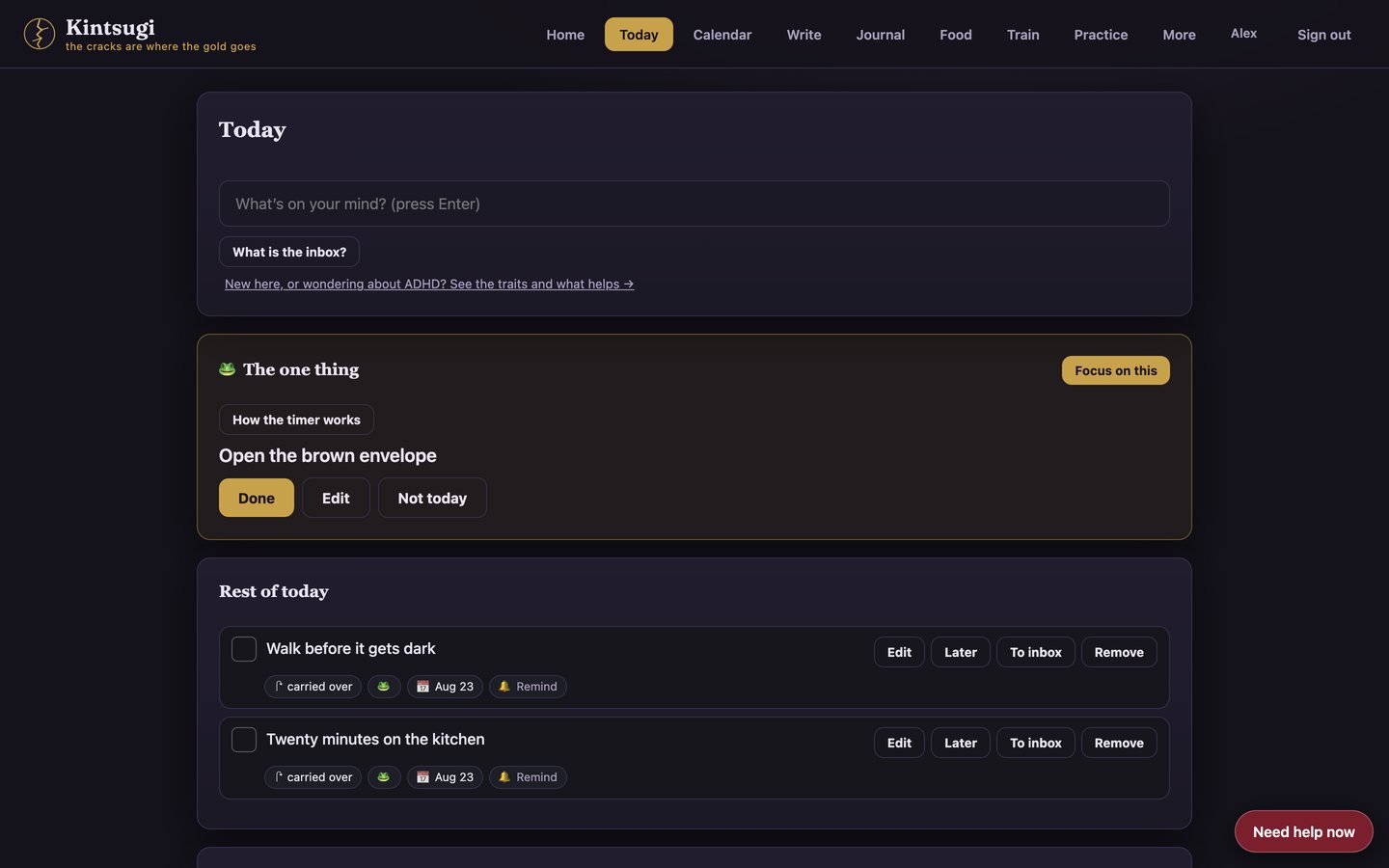
The planner, showing one nominated task for the day above an inbox of everything else.
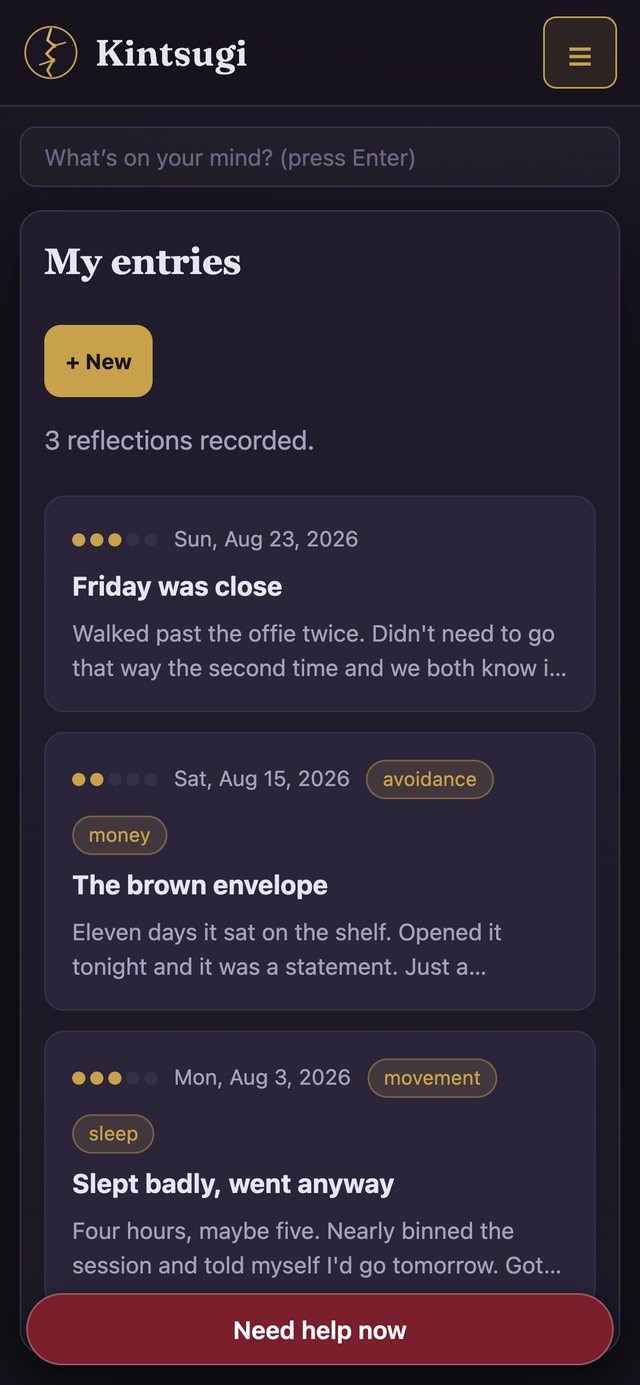
Journal entries with mood dots and tags, dated across a fortnight.

The writing screen, with a guided prompt and a blank page to answer it in.

The prompt library, with prompts grouped by what you might be sitting with.

Short practices, each labelled with its type and how many minutes it takes.

Bodyweight training sessions, each with a difficulty label and an easier version.
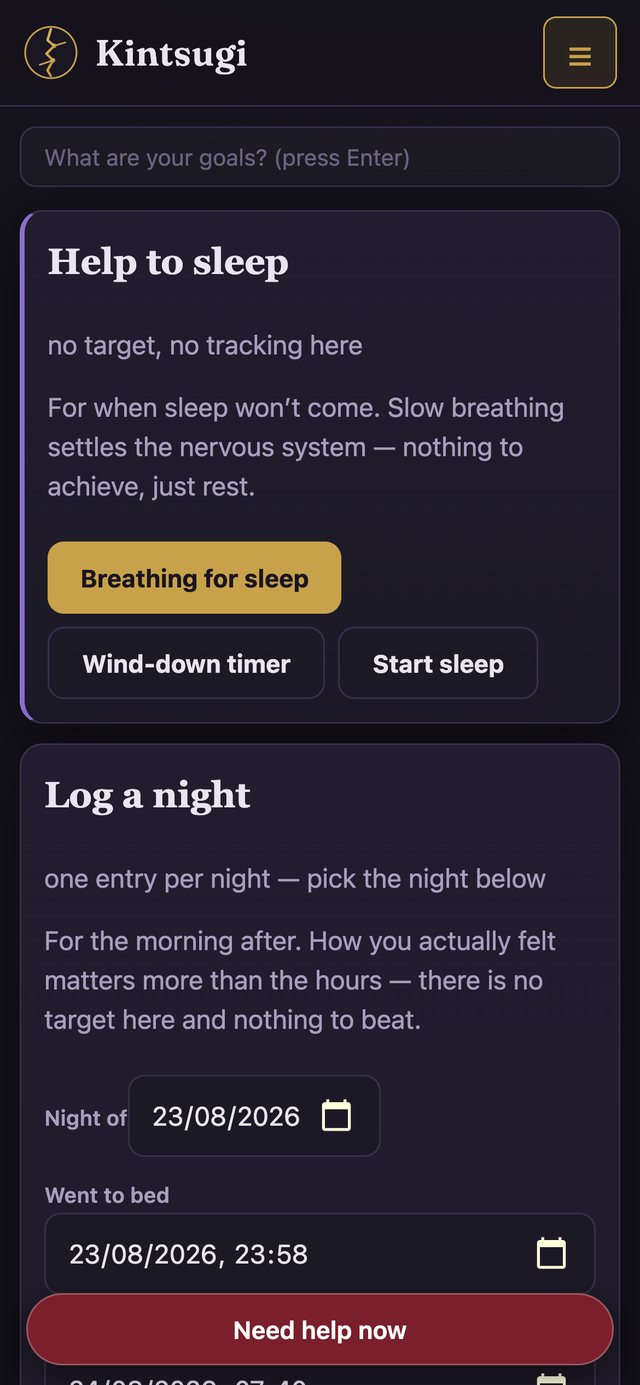
The sleep screen, with winding down offered before any logging.

The calendar, showing what was logged across the month at a glance.

Insights drawn from what has been logged over time, without a score attached.
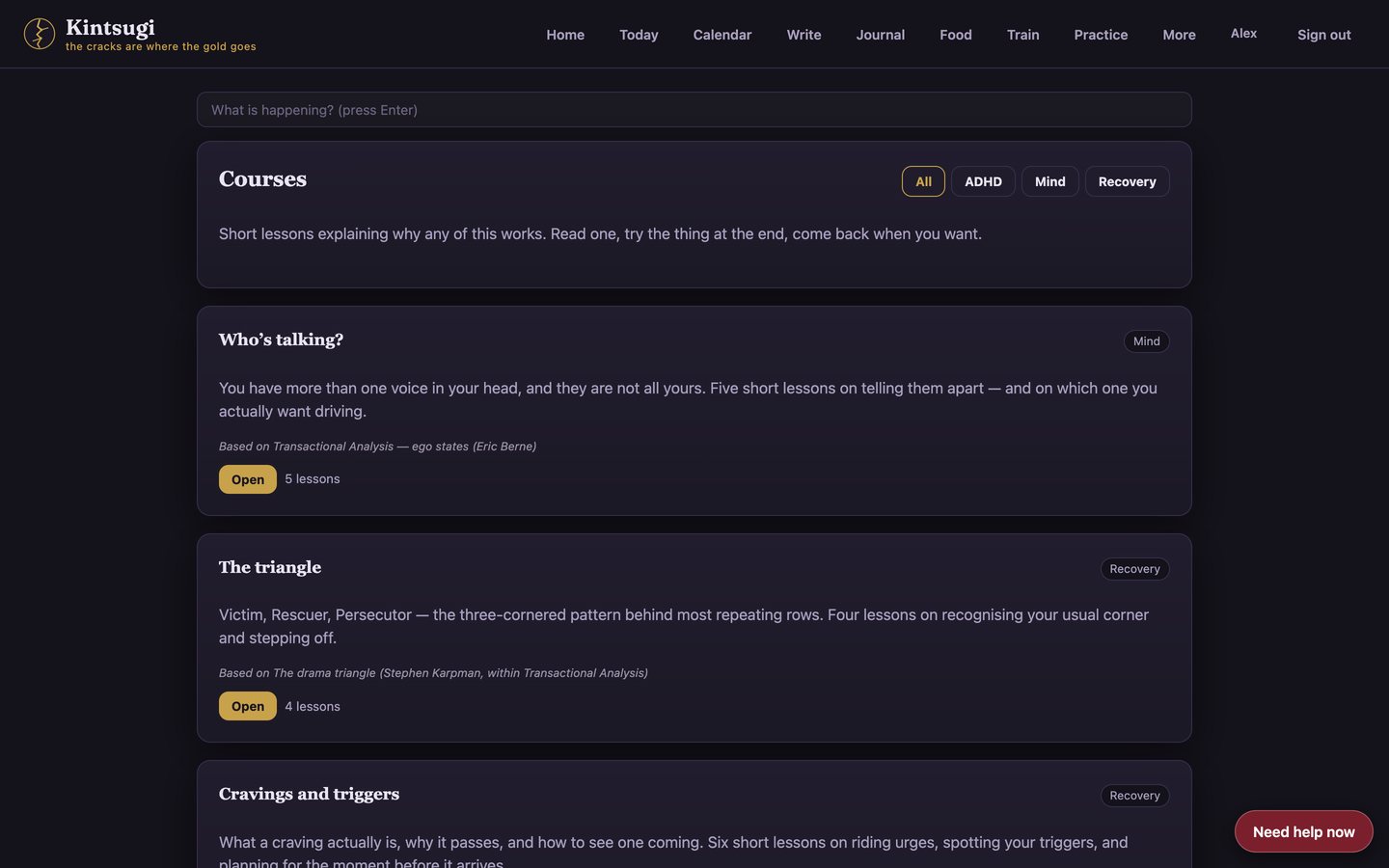
The course library, covering patterns, ADHD, grief, money and sleep in plain language.

Routines for mornings and wind-downs, built from small steps.
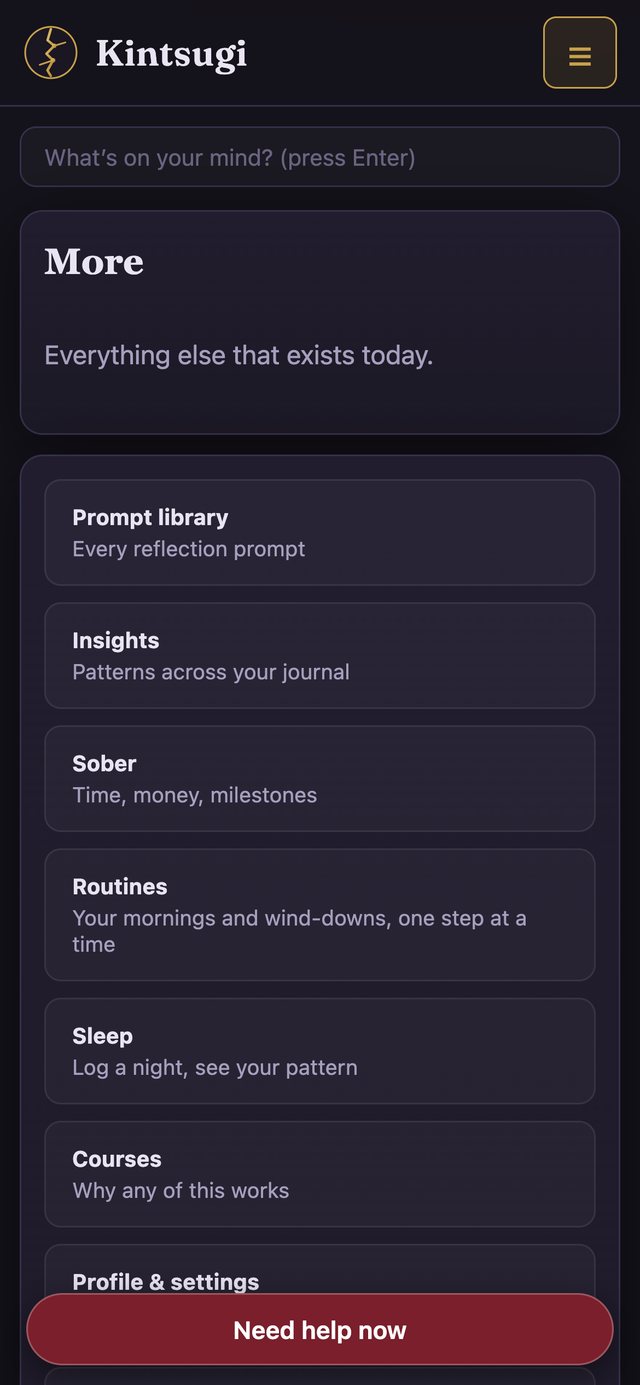
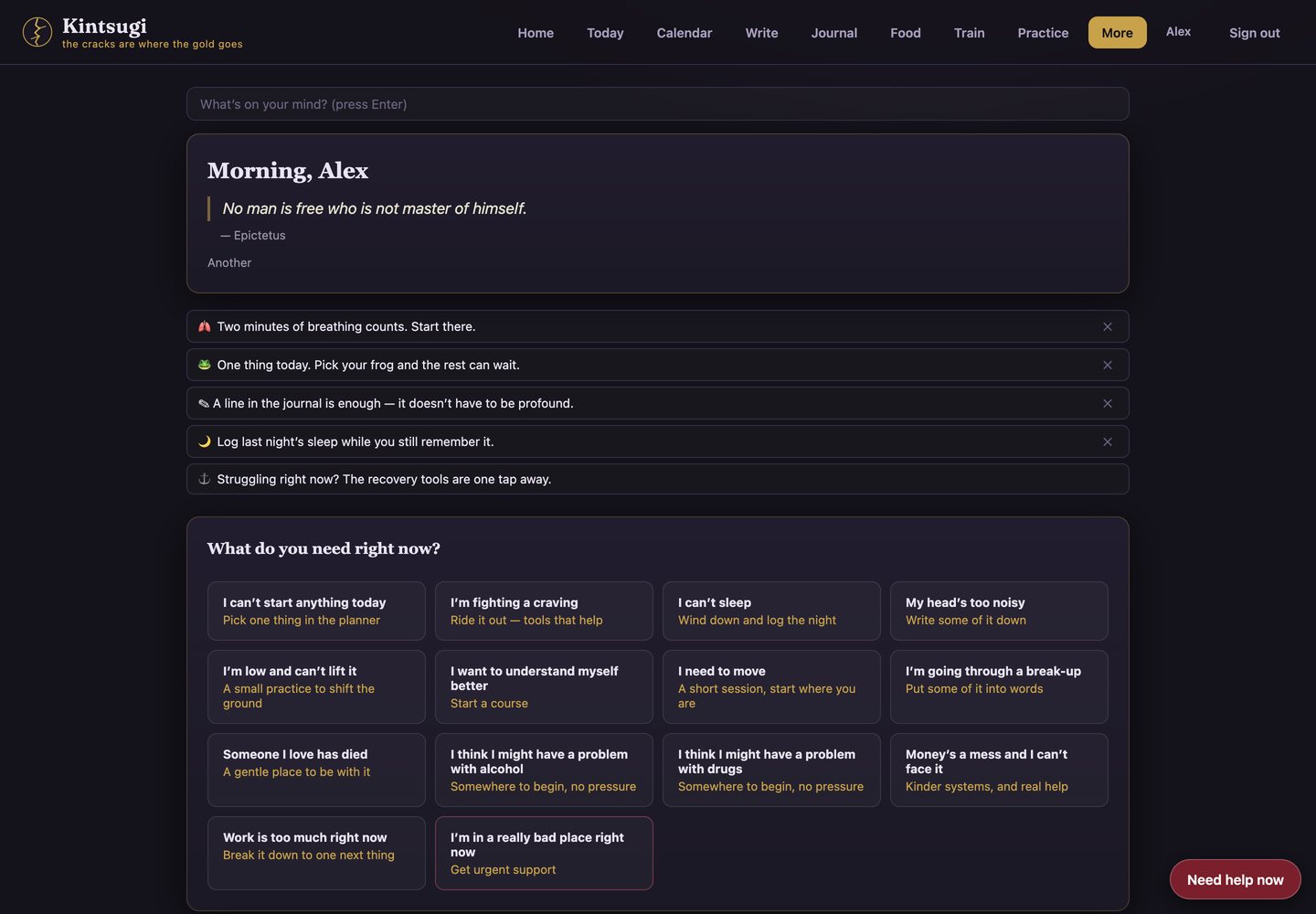
Everything Kintsugi holds on one screen: recovery, insights, sleep, courses, community, chat, the practitioner directory and finding help.

The find-help directory, listing real services and how to reach them.
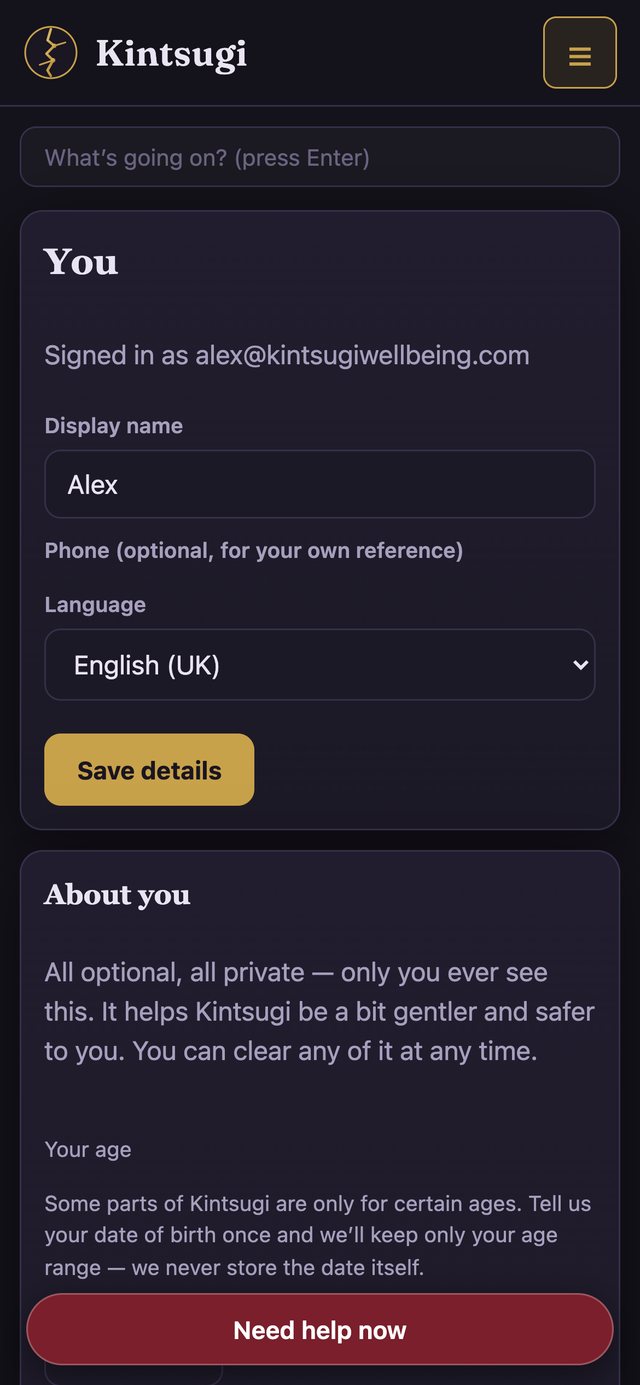
Profile and settings, including what is recorded and how to export or erase it.

The recovery screen in Journey mode: every well day counted once and kept, with milestones that a lapse never takes back.

The recovery screen in Day counter mode, showing time since the last change.
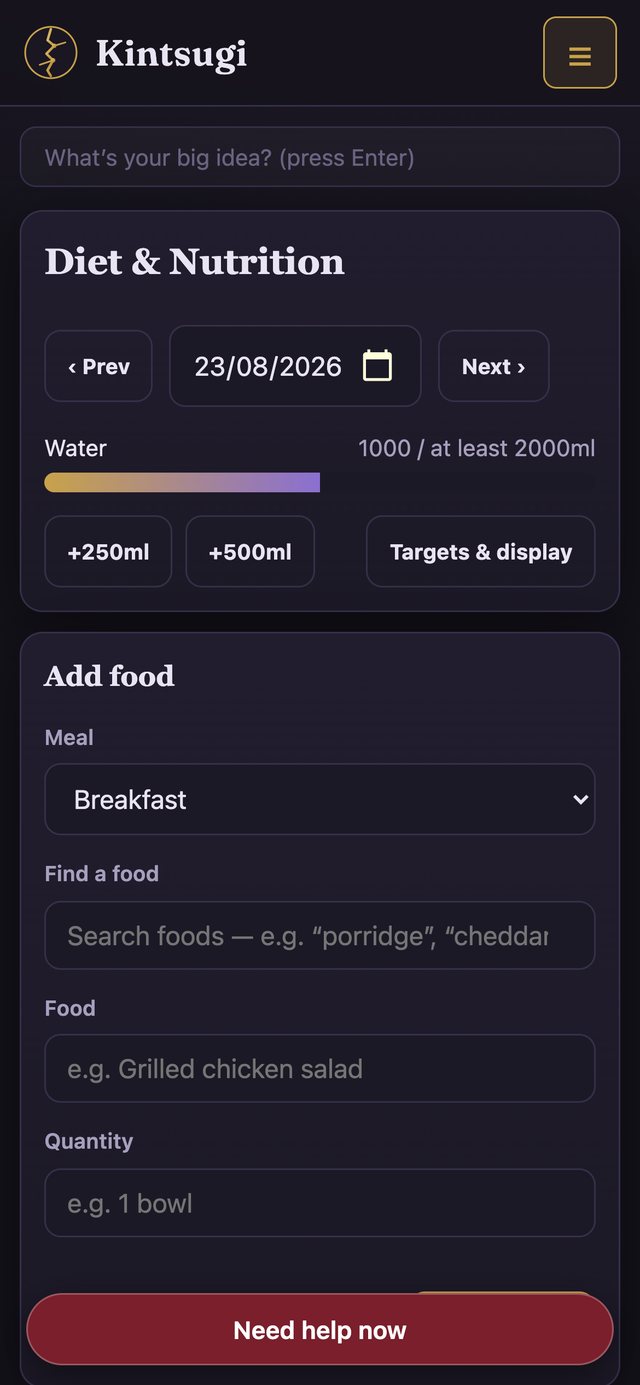
A day of food and drink logged with the numbers off — the setting Kintsugi ships with.
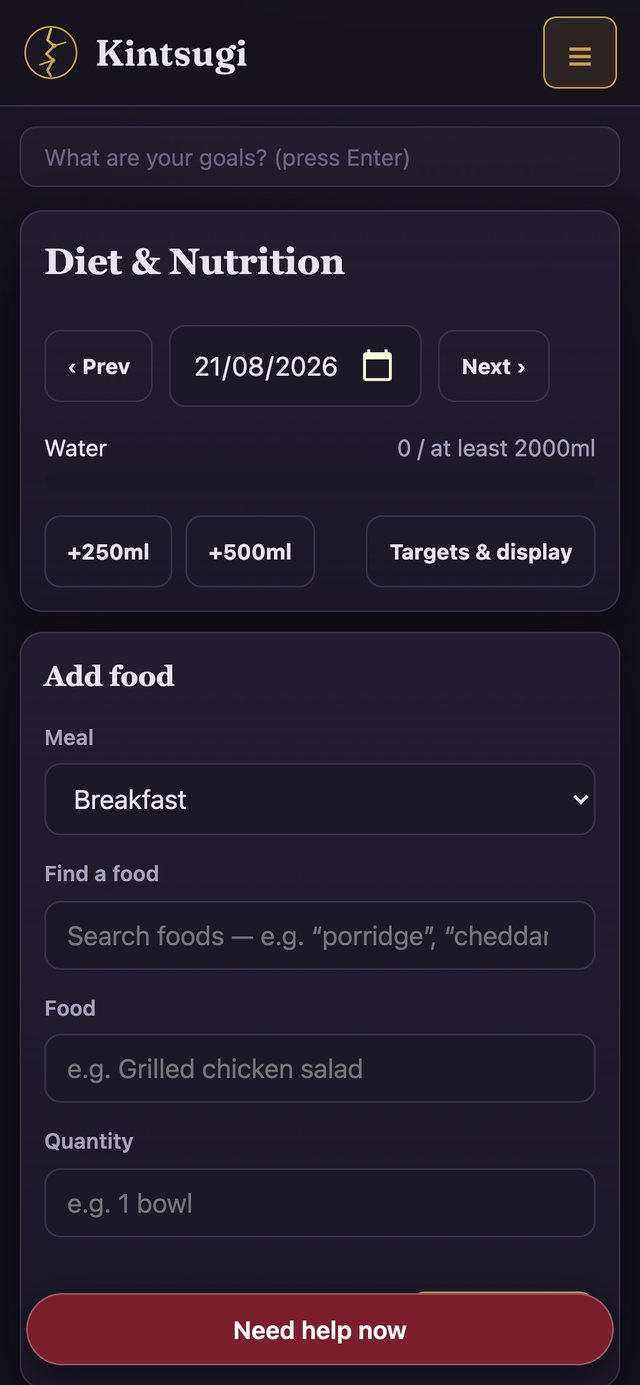
The same food log with calorie, protein and water references switched on by choice.
Diagnosed with ADHD, on a waiting list, or fairly sure and never pursued it. The gap between meaning to and doing, which most planners answer with a longer list.
Alcohol, drugs, gambling, or a habit with no name. Early days, years in, or starting again after a stretch that did not hold.
A break-up, a death, a job gone, health changed. The stage where everyone assumes you are fine and the shape of your week has not grown back.
Trauma, named or not, showing up as sleep that will not come or a temper that arrives too fast. The app holds the scaffolding while the real work happens with a person.
These were written down before the code was, and each one has cost us a feature that would otherwise have shipped. That is how you tell whether a principle is real.
No streaks, no longest run, no completion percentage and nothing that turns red. Food targets are off unless you ask for them. A hard day is entered as a day, and every day in front of it stays in the record.
Export what you have written, whenever you want. Close the account and it is taken out of reach at once and permanently removed after a short grace period — with a record that it happened, and no quiet copy kept for analytics.
No advertising, no data sold or shared with brokers, and nothing you write used to train a model. Access to health data is denied by default and every decision is logged — the refusals as well as the grants.
A set of tools, not treatment. It does not diagnose anything, it does not replace a professional, and it is not staffed. Where you need a person, it points at the people who are actually there.
It is a set of tools for the ordinary work of a day. It does not diagnose anything, it does not replace a GP, a therapist or a support group, and it is not staffed. If you need someone now, the people who can help are listed on our support page.
Streaks work. That is the problem. Here is the reasoning behind cutting the single most effective retention mechanic in consumer software out of an app about recovery.
Most task apps let you flag everything as important. Kintsugi lets you nominate exactly one thing a day, and holds you to it.
If you have used something that made a bad week feel like a deleted save file, this was built by someone who thought that was a design failure rather than a personal one.